
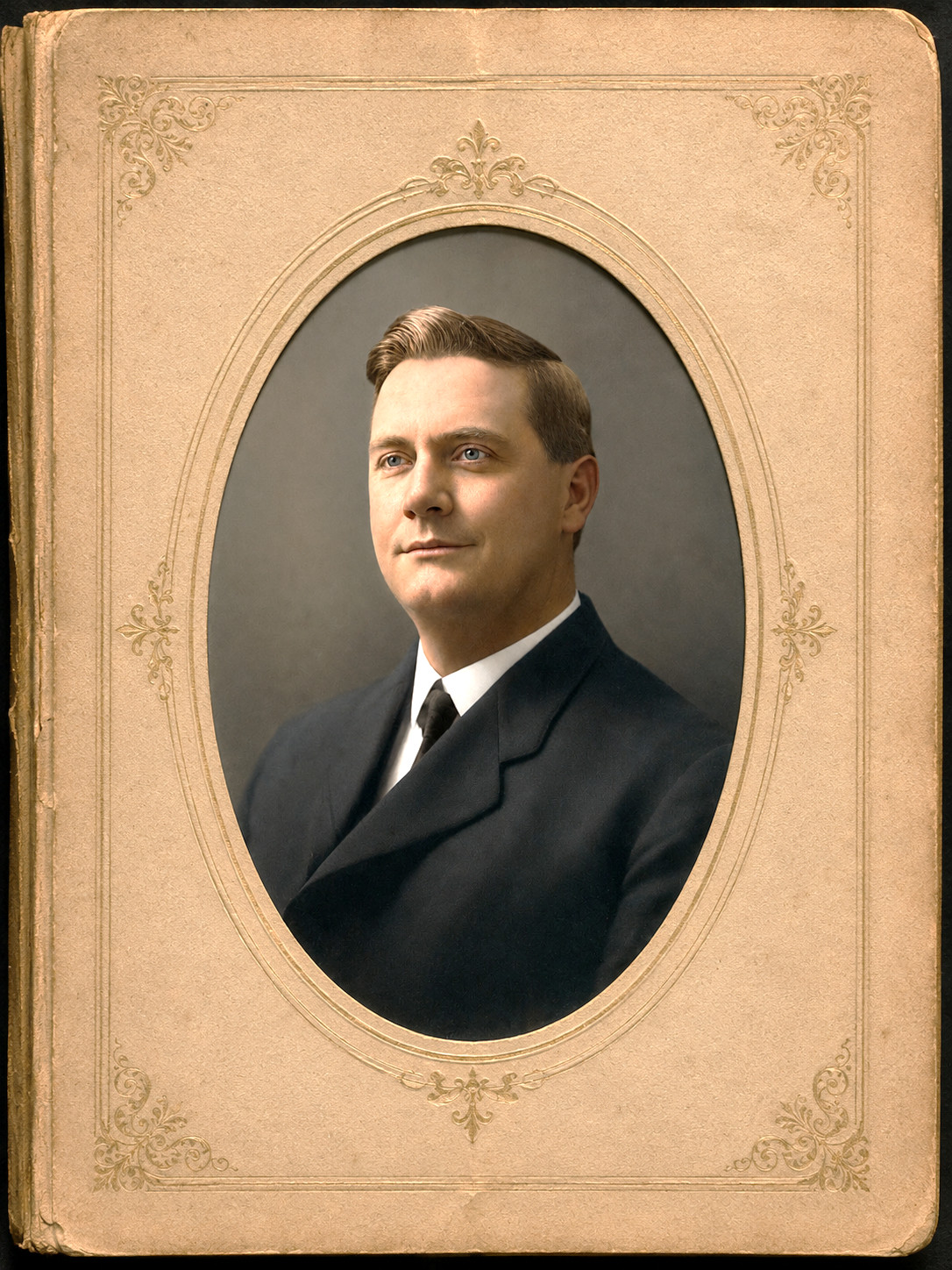
An illustrated biography based on family records, church
registers,
contemporary newspapers, photographs, and surviving sheet music
Prepared July 2026; updated August 2026
Family origins and childhood
Luther Franklin Mezick was born in early 1869 in the Capitola-Clara area of southwest Wicomico County on Maryland's lower Eastern Shore. His gravestone gives 11 January 1869 as his date of birth. His Virginia death certificate, however, gives the birth date as 17 February 1869 and an age calculated from that date.
Luther's parents
His father, Isaac Francis Mezick, was born 20 May 1839 in the same general community. Isaac served for many years as a Justice of the Peace, first for Somerset County and later for Wicomico County after its creation. He was also identified in census and family material as a farmer and, later, a shipper of agricultural produce. He is listed with the honorific “Dr.” in several documents. Luther consequently grew up in a household connected both to rural work and to the civic life of the neighborhood.
Luther's mother, Elizabeth Jane White, was born 25 May 1840 in Somerset County, the daughter of Henry White and Sarah L. “Sally” Ellis. She first married Thomas Benjamin Franklin Hughes in 1857 in Forktown (present-day Fruitland) and had four known children with him:
Caleb Ernest Hughes 1858-1870
Charles Venables Hughes 1859-1930
Lillie Mary Hughes 1861-1943
Thomas Jefferson Davis Hughes 1863-1932
Family tradition says Thomas died in 1864 when a hogshead of whiskey fell upon him. The story is striking, particularly in light of Luther's later temperance career, but no evidence presently shows that the accident story shaped his beliefs.
Elizabeth White married Isaac Francis Mezick on 14 March 1868. They had seven known children together:
Luther Franklin Mezick 1869-1917
Millard Milton Mezick 1870-1927
Gurney Washington Mezick 1872-1952
Hurvey Clark Mezick 1874-1947
Otis Latimer Mezick 1876-1953
Sarah Ella Mezick 1879-1970
Addie Grace Mezick 1882-1895
With her four Hughes children, Elizabeth was the mother of eleven presently identified children. One source reportedly described her as the mother of fourteen, suggesting that three additional children may have died young, been omitted from surviving lists, or were counted in error.
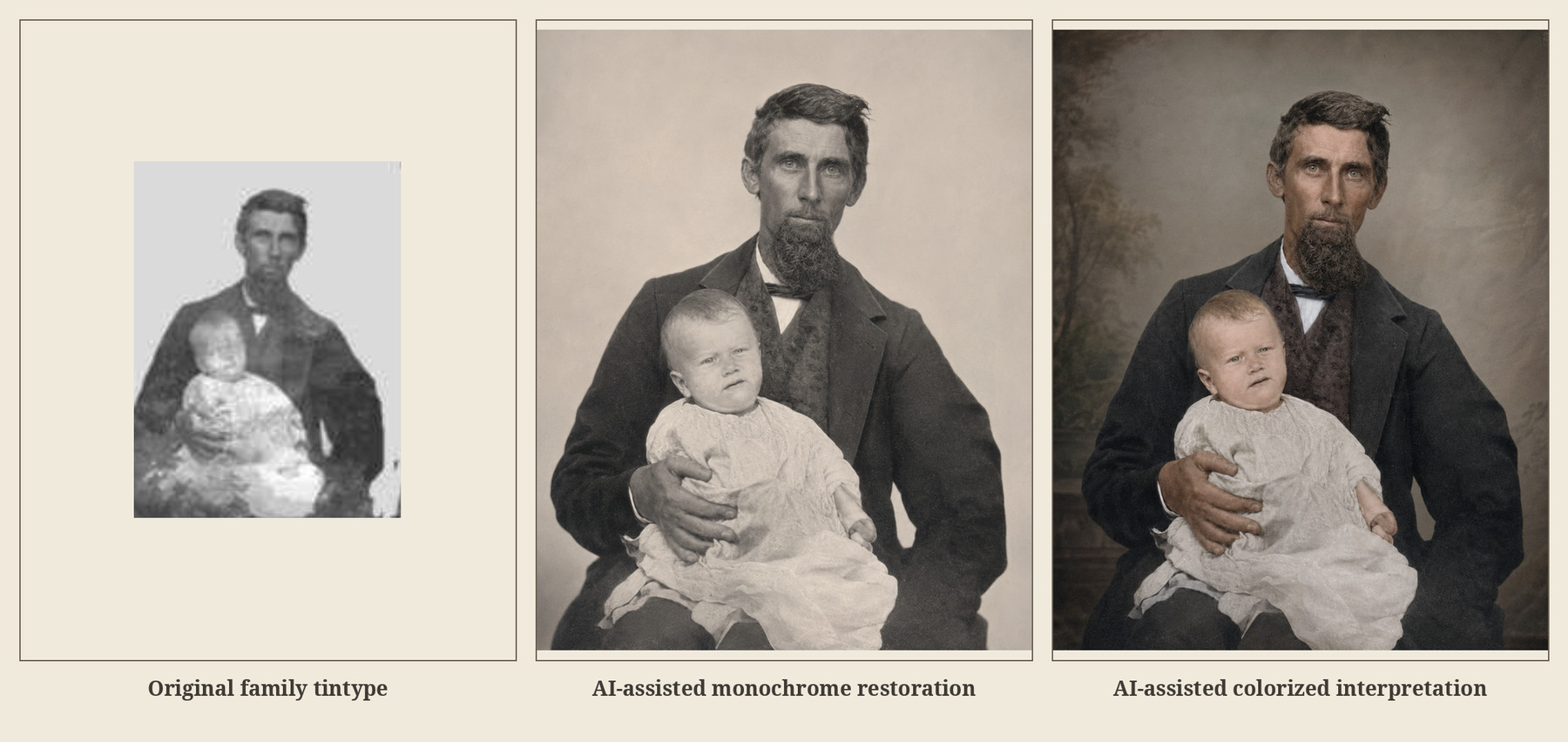
The tintype is the earliest known image associated with Luther. Isaac, about thirty years old, sits formally with his infant son on his lap. Even in its damaged state, the photograph provides an unusually intimate opening to Luther's story: the future singer and evangelist appears first as a baby held securely by a father who would remain a prominent local figure for decades.
Massey's, Trinity Methodist Episcopal Church, and marriage
Methodism formed the religious framework of Luther's life. Both Luther Mezick and Carrie Robertson appear in class lists for Massey's, the local name associated with Trinity Methodist Episcopal Church at Clara. In nineteenth-century Methodism, the class was central to church life, a recognized unit of membership, prayer, testimony, instruction, and spiritual oversight. Their appearance in the lists is direct evidence that the church was not merely a convenient wedding location but part of their shared religious community.
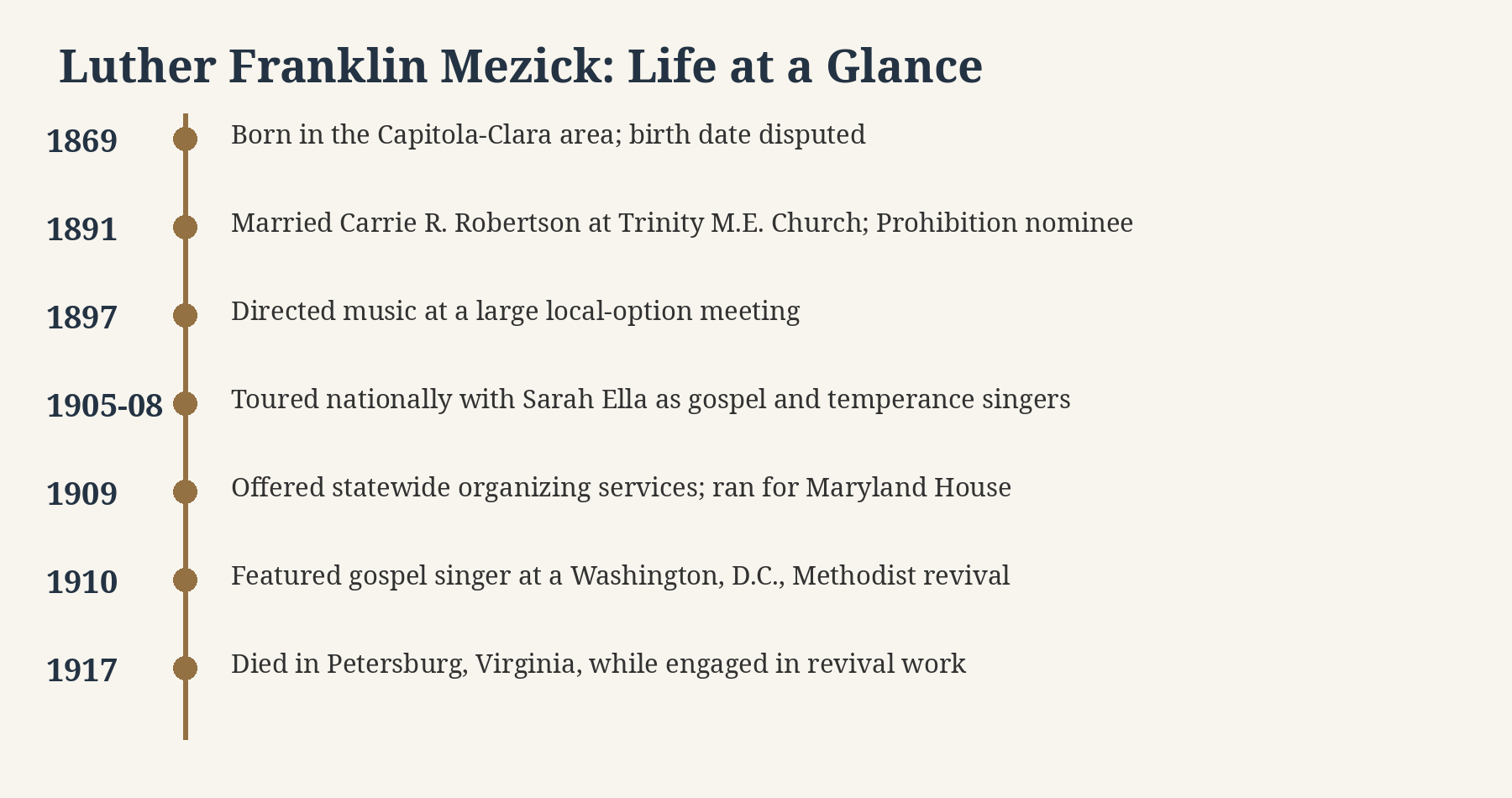
On 24 June 1891, Luther and Carrie were married by the Rev. F. J. Cochran. The church register names them as 'Luther F. Mezick' and 'Carrie R. Robertson,' both residing at Capitola. Luther was twenty-two, Carrie twenty, and Luther's occupation was farmer. The remarks column states that they were married in Trinity M.E. Church. Read together with the Massey's class lists, the record strongly supports the identification of Massey's as the congregation's familiar local name and Trinity as its formal church name.
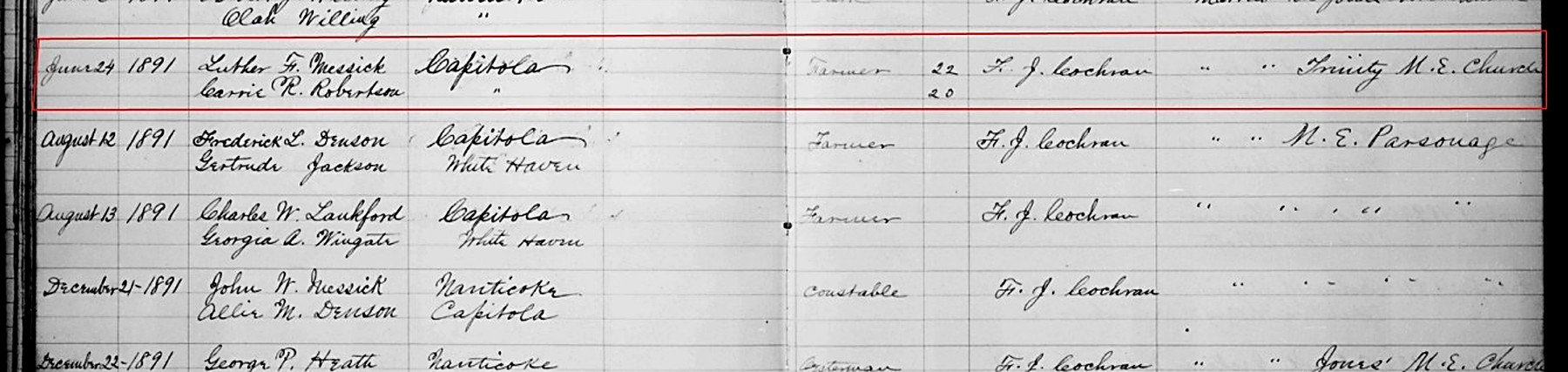
The entry gives both parties as residents of Capitola and records the ceremony in Trinity M.E. Church.
Carrie Roberta Robertson was born 21 August 1870 in Clara, the daughter of James Washington Thomas Robertson and Esther Adeline Evans Robertson. J.W.T. Robertson was a prominent citizen of the area. Census records record his occupation as sailor (1870), farmer and merchant (1880), farmer (1900, 1910), and well driver (death certificate). His obituary said he was a retired farmer and waterman, a devout churchman and an ardent prohibitionist. He was nominated in 1891 for delegate to the Maryland state convention and in 1917 he ran for the Maryland House of Delegates, both on the Prohibition ticket. In 1931, at the age of 81, he tapped an artesian well on Gen. Amos W.W. Woodcock’s property, Chatillon, along the Wicomico River south of Salisbury. A powerful 6-8 foot plume of water streamed from the well, earning it the nickname “Old Faithful”. Gen. Woodcock had a marble plaque inscribed and placed next to the well to commemorate the fact that the well was driven by Capt. J. W. Robertson of Whitehaven. Today, the well is surrounded by a low, oval brick wall along the 800 block of Riverside Drive.
Luther and Carrie had three known children: Audrey, born in 1893; Evan Carlyle, born in 1898; and Herbert Luther, born in 1900. Audrey later became part of Luther's traveling musical work. Carrie's long widowhood and the later records of their children kept Luther's name present in the family and community well after his early death.
A young farmer enters public life
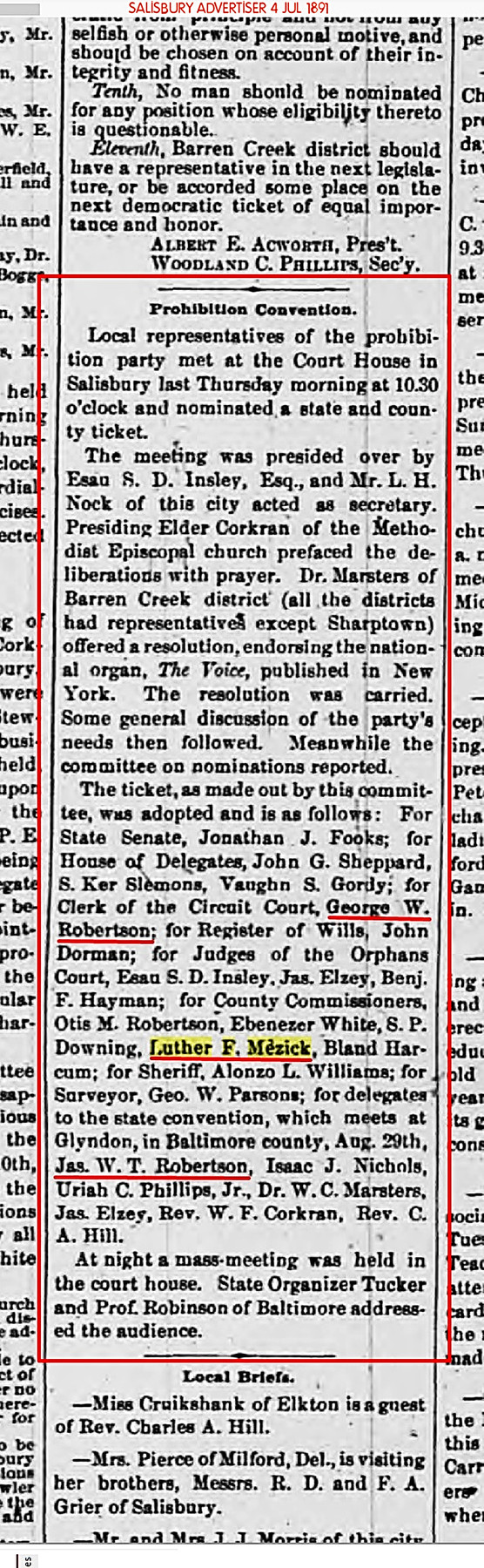
Luther entered public life almost immediately after his marriage. The Salisbury Advertiser reported on 4 July 1891 that the Wicomico County Prohibition Party had nominated Luther F. Mezick for county commissioner. He was only twenty-two and had been married for ten days. The nomination shows that temperance and political reform were not late additions to his career; they were already part of his public identity at the threshold of adulthood.
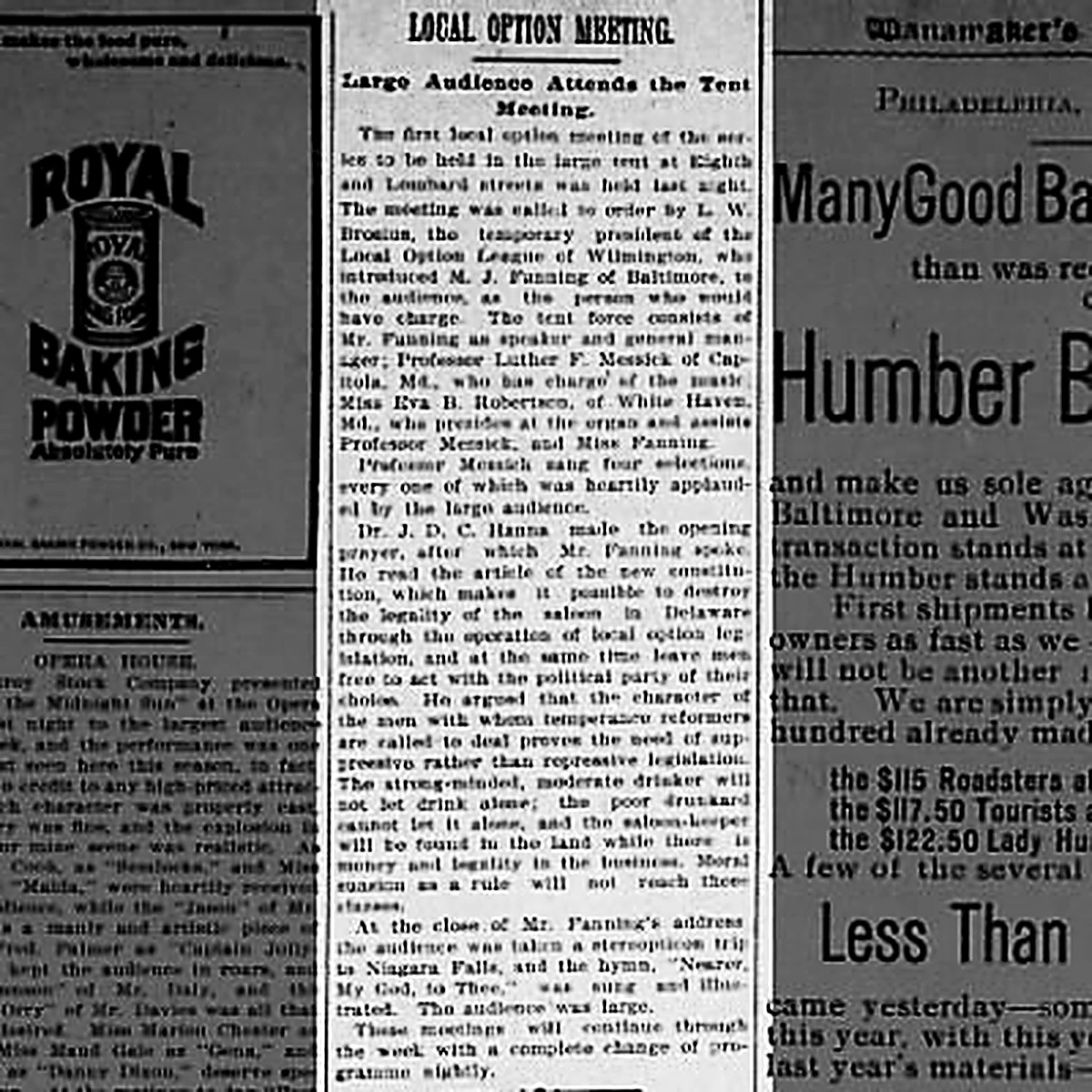
By 1897, newspapers were referring to him as 'Professor Luther F. Messick of Capitola.' The honorific 'Professor' was often applied to professional music teachers, directors, lecturers, and performers and does not necessarily imply a collegiate appointment. At a large local-option meeting that year, Luther directed the music while Eva B. Robertson of White Haven, Carrie’s sister, played the organ. The report places him at the intersection of church music, public reform, and mass persuasion that would define the remainder of his life.
Composer, lyricist, and publisher
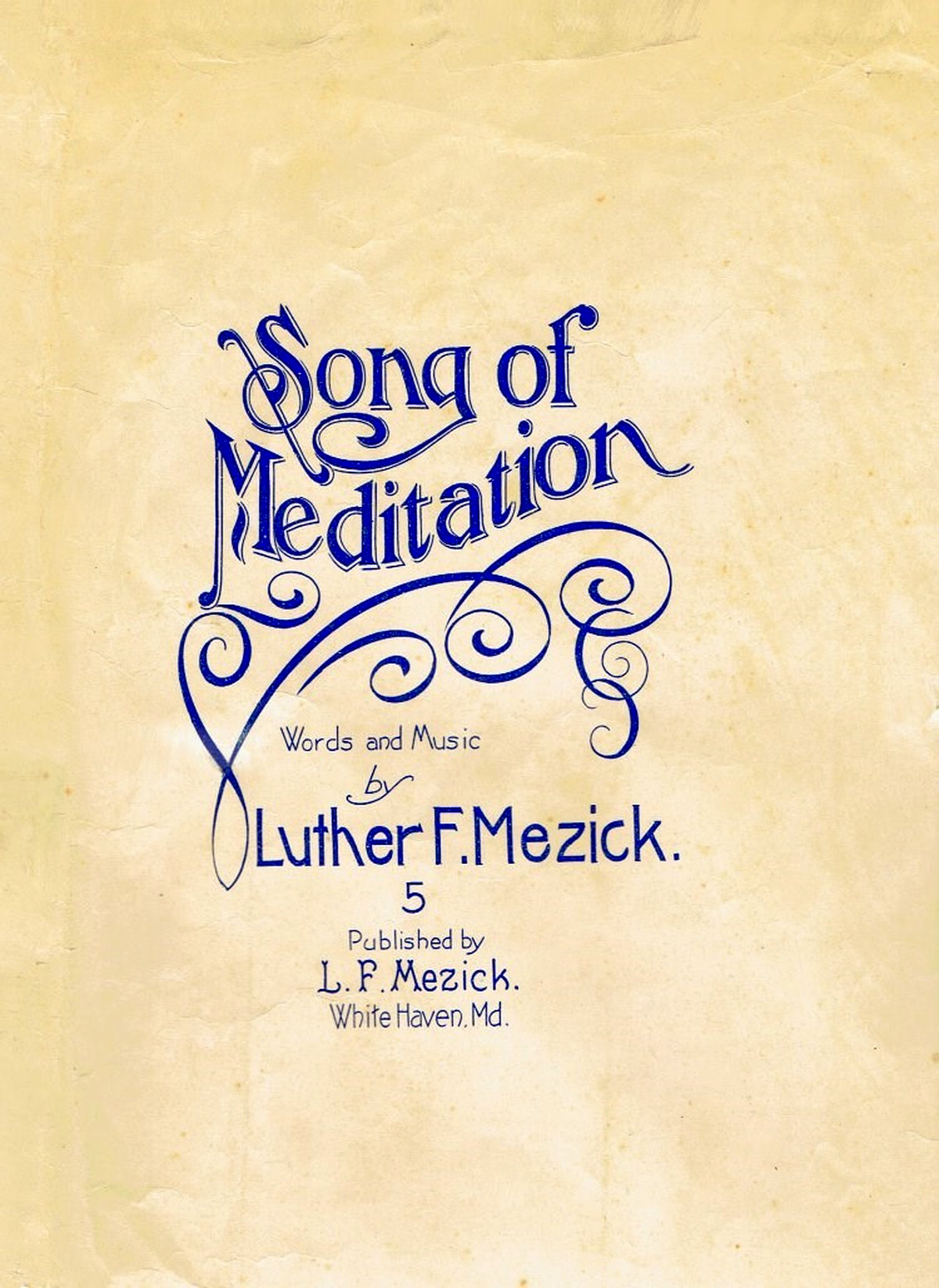
Luther was not merely an interpreter of other people's hymns. A surviving cover for Song of Meditation credits him with both the words and music and identifies the publisher as 'L. F. Mezick, White Haven, Md.' This establishes him as a lyricist, composer, and at least occasional self-publisher. The cover's ornate lettering and professional design suggest that the work was intended for circulation and sale rather than solely for private family use.
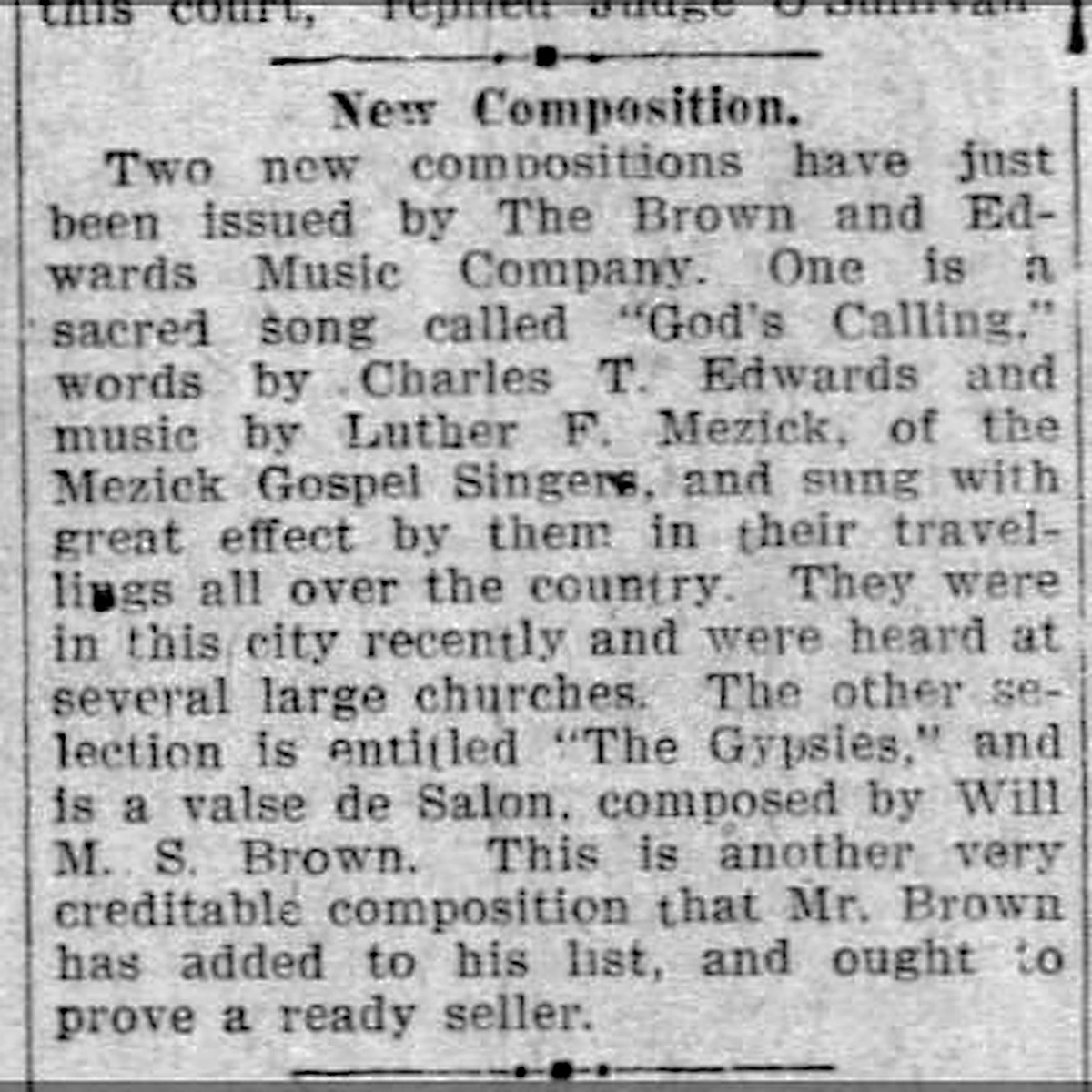
A second sacred composition, God's Calling, joined Luther's music to words by Charles T. Edwards and was issued by the Brown and Edwards Music Company. A contemporary notice said the Mezick Gospel Singers performed the song with great effect during their travels. The two surviving references reveal more than a hobby: Luther wrote his own devotional texts, composed melodies, worked with another lyricist and commercial publisher, and promoted his music through live performance.
The Mezick Gospel Singers: Luther and Sarah Ella
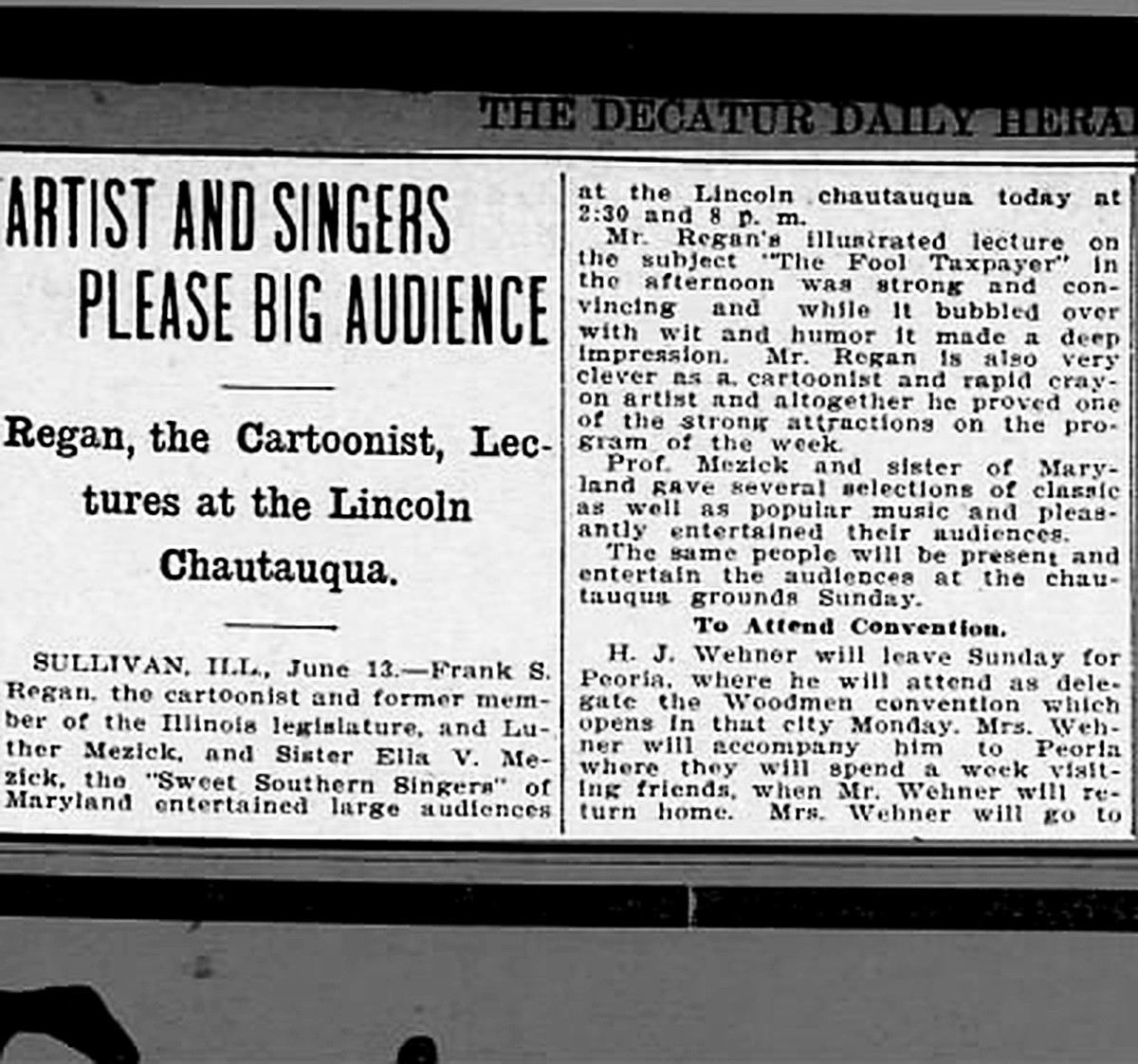
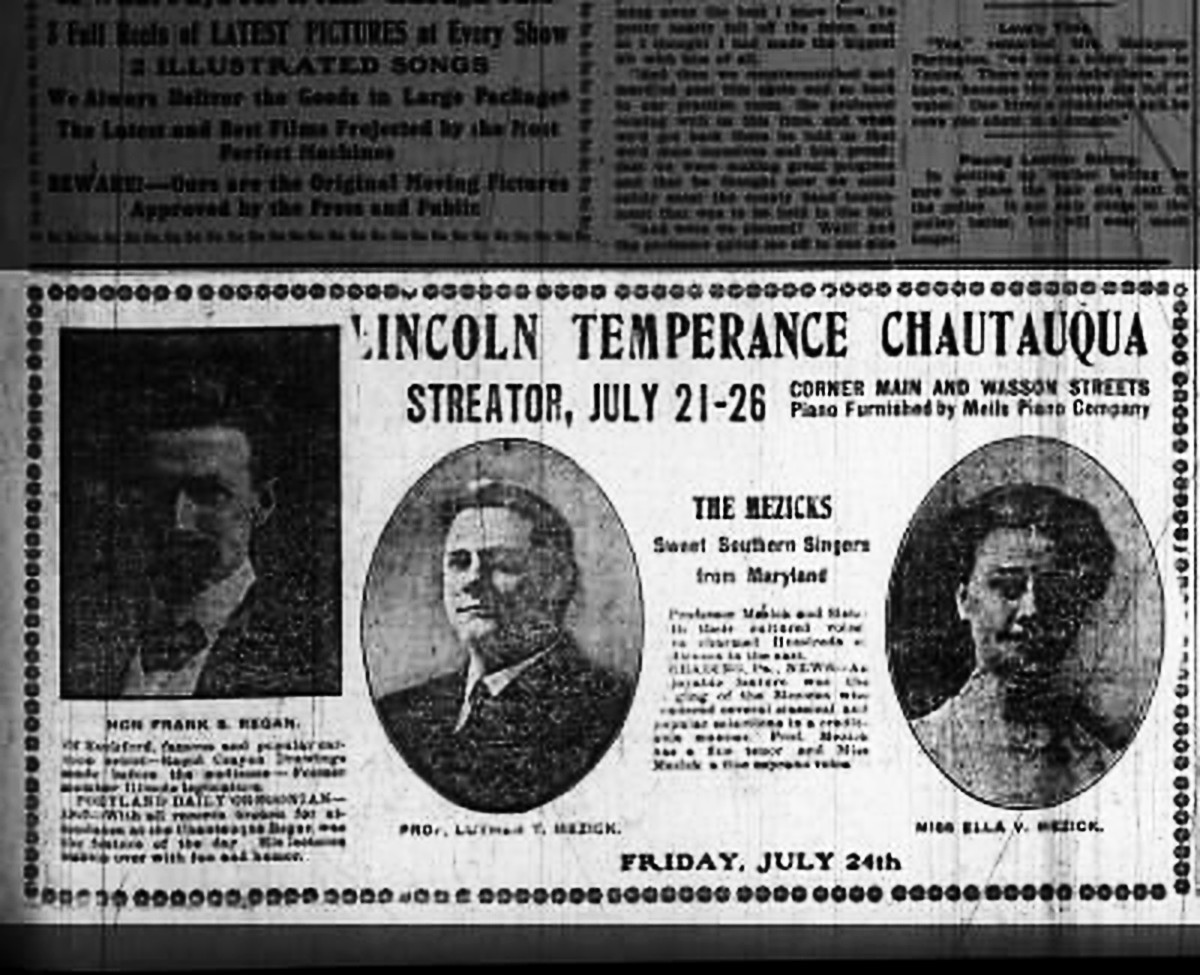
Luther's best-documented early touring partner was his younger sister Sarah Ella Mezick, born 20 November 1879, probably in the Capitola-Clara area. Advertisements and newspaper reports called the pair 'The Mezicks,' 'The Mezick Gospel Singers,' and the 'Sweet Southern Singers from Maryland.' Their programs blended sacred, temperance, patriotic, popular, and classical music. They appeared not only in churches but also in courthouses, convention halls, and Chautauqua assemblies, where reform lectures and wholesome entertainment shared the same stage.
By 1905, Luther and Ella were appearing with prohibition lecturer H. D. Patton as the Patton-Mezick Trio. Reports from the Midwest described Luther and his sister as singers whose words could be understood and whose gospel music moved audiences deeply. In 1907 they were advertised for Prohibition meetings at the courthouse in Danville, Pennsylvania. In 1908 they appeared on Lincoln Temperance Chautauqua programs in Illinois, where their portraits and names were used as featured attractions.
Additional online newspaper research sharpens this touring timeline. A July 1903 notice in the Peninsula Enterprise of Accomac County, Virginia, says that “Prof. Mezick” would lead the singing. Because the notice does not give a first name, its identification with Luther is probable rather than certain. On 18 February 1905, the Fairmont West Virginian advertised Prof. Mezick and his sister as gospel singers from Maryland. On 23 April 1906, the same newspaper again reported Mezick and Miss Ella Mezick singing at Willard Hall. Most decisively, the Cumberland Evening Times of 30 August 1907 explicitly named Luther F. Mezick and his sister Miss Ella Mezick as singers engaged for a Prohibition conference. Taken together, these notices independently confirm the sibling act and extend its documented or strongly supported geography into Virginia, West Virginia, and western Maryland.
Ella's marriage provides a natural dividing line in the partnership. On 28 April 1909 she married Prescott Gillilan of Jackson County, Ohio, himself a Prohibition Party organizer. Her marriage did not take her away from the reform world so much as place her within another branch of it. The couple settled in Columbus, where their children Frances Eliza, Howard Sheldon, and Sarah Irene Gillilan were born. Sarah Ella Gillilan lived until 16 March 1970, more than half a century after Luther's death.
Audrey, national organizing, and political candidacy
After Ella's marriage, Luther's daughter Audrey became his principal family singing partner. A surviving promotional booklet described 'Professor Mezick and his daughter' as temperance and gospel singers who had traveled through much of the United States and had worked for the National Prohibition Committee. Promotional testimonials must be read as advertising, but they show how Luther and Audrey were presented to potential sponsors: not as local amateurs, but as experienced national campaign performers.
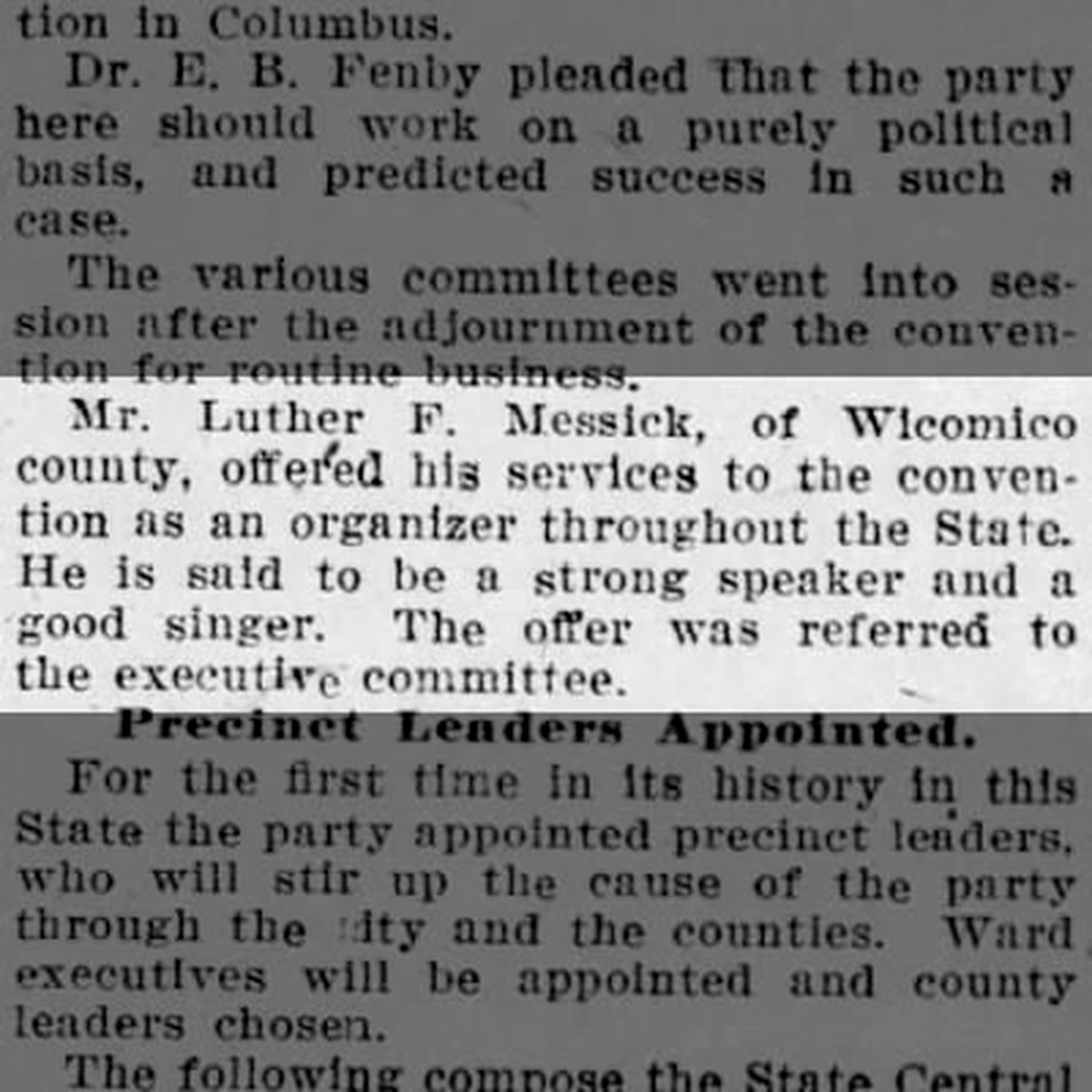
In 1909 Luther offered his services to the Maryland Prohibition convention as an organizer throughout the state. A newspaper described him as a strong speaker and a good singer and reported that he proposed taking his family into cities, towns, and villages to hold mass meetings that combined oratory, singing, and music. This was a practical campaign model for the period: a traveling family program could draw an audience, entertain it, and then direct its attention toward religious conversion and political reform.
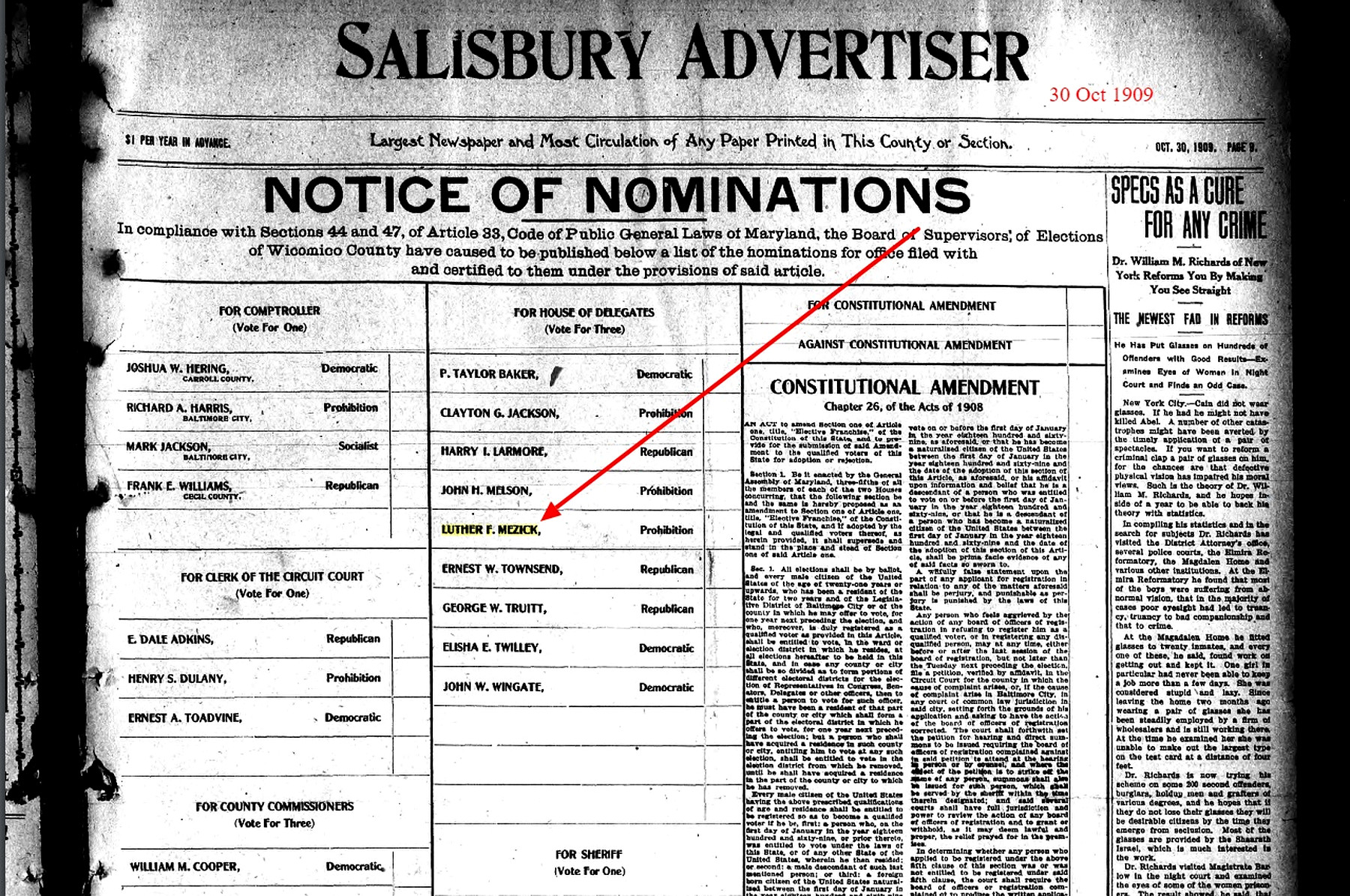
That year he also stood as the Prohibition Party candidate for the Maryland House of Delegates from Wicomico County. The candidacy did not make him a major-party politician, but it shows that his convictions extended beyond the platform and songbook. He was willing to place his name on the ballot and to represent a reform movement whose electoral prospects were limited but whose ideas were reshaping public debate.
From temperance platform to revival ministry
Luther's religious and political work were never neatly separated. Temperance meetings often opened with prayer, used gospel music to build emotional unity, and presented abstinence as both a spiritual and civic duty. Methodist revivals likewise welcomed music that could carry a message beyond the spoken sermon. Luther's particular talent was to move comfortably between those settings.
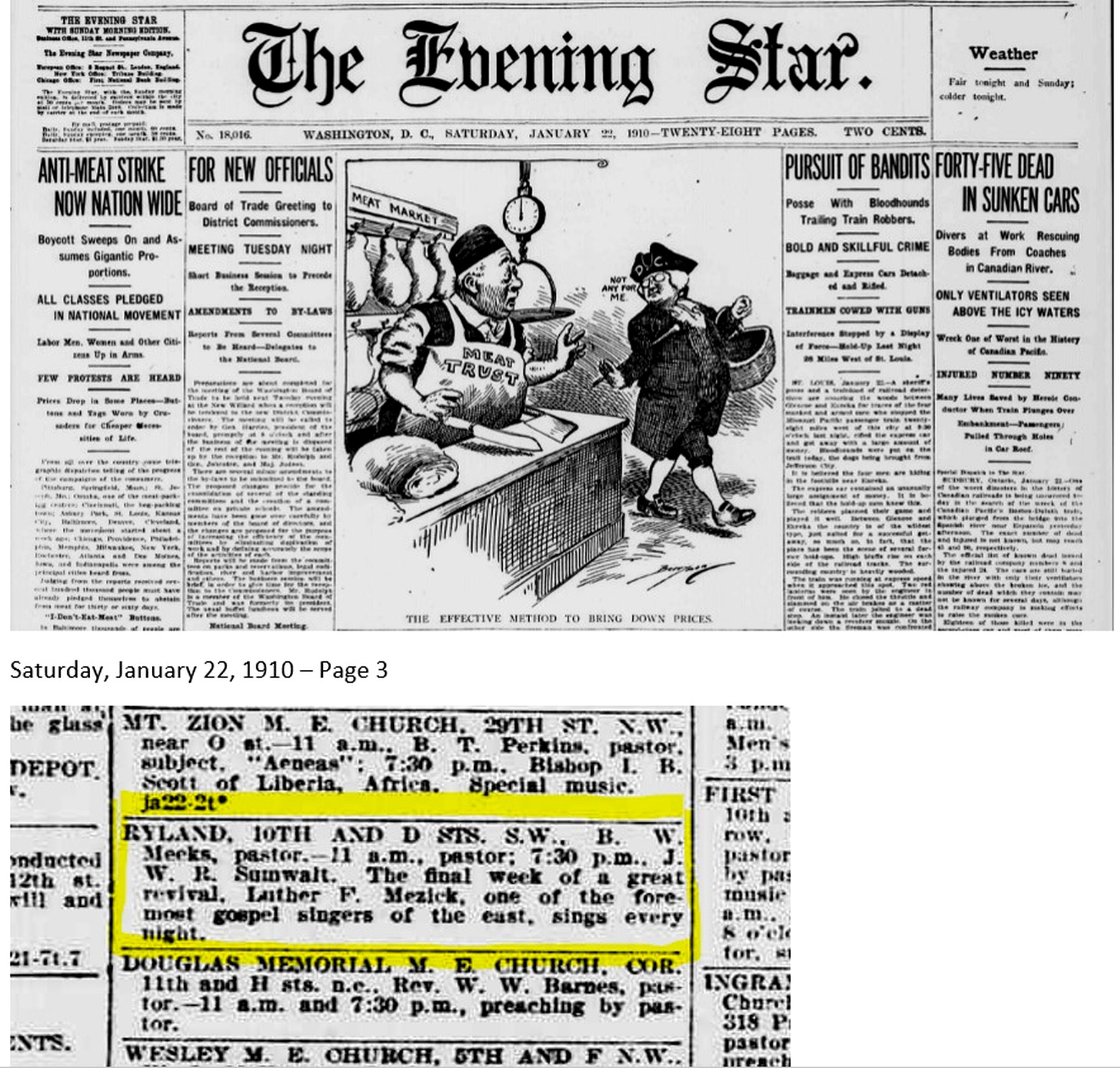
In January 1910, a Washington, D.C., notice advertised him during a revival at Ryland Methodist Episcopal Church and called him 'one of the foremost gospel singers of the East.' He was scheduled to sing each night. The phrase is promotional, but it demonstrates the professional reputation under which he was being booked far from home.
1911: a singing evangelist “of Philadelphia”
A newly located newspaper report adds an important dimension to Luther's ministry. On 14 July 1911, condemned prisoner Reese Roberts was executed at the New Castle County Workhouse in Delaware. The following day's Philadelphia Inquirer reported that the final religious services were conducted by the Rev. Ralph T. Coursey and Rev. Luther F. Mezick. It described Mezick as being “of Philadelphia” and as a singing evangelist of the Methodist Episcopal Church.
This evidence shows Luther functioning in an explicitly pastoral setting, not simply appearing as musical entertainment at a revival or reform meeting. The newspaper's use of the title “Rev.” is significant, but it does not by itself prove formal ordination; Methodist evangelists and licensed local preachers could be styled in ways that do not map neatly onto modern assumptions about ministerial status. Likewise, “of Philadelphia” may indicate his professional base at the time rather than establish permanent residence. Both questions deserve further investigation in Philadelphia city directories and Methodist conference records.
Prohibition work after the 1909 campaign
A later newspaper retrospective in the Somerset County digital archive preserves another useful report: Luther Messick of White Haven was listed among Eastern Shore delegates who attended a Prohibition convention in Atlantic City. The retrospective appears to reproduce an item from the early 1910s, but the original newspaper issue and exact date have not yet been relocated. For that reason, the convention is evidence that Luther's organized Prohibition activity continued after his 1909 candidacy, but it is not assigned a precise year in the chronology below.
The record that survives is fragmentary, yet it outlines a sustained career. Contemporary notices now document or strongly support Luther's activity in Maryland, Virginia, West Virginia, Pennsylvania, Delaware, the District of Columbia, Kansas, Illinois, and other places reached by the temperance and Chautauqua circuits. He sang with his sister, later with his daughter, composed and published music, lectured, organized meetings, participated in Methodist revival work, and by 1911 was being described in a major newspaper as a Methodist Episcopal singing evangelist. His career was national in reach even though it remained rooted in the small Eastern Shore congregations that formed him.
Family life and the objects he left behind
Travel was central to Luther's public life, but the surviving evidence repeatedly brings the family into the work. Ella sang beside him during the earlier years. Audrey later traveled as his daughter and musical partner. Carrie belonged to the same Methodist class community and maintained the household through years in which Luther's employment often required absence from home.
A family transcription of Luther's will provides a personal glimpse that formal publicity cannot. He left his guitars to his daughter, his gun to his oldest son, and his watch to his second son. The remainder of his property went to Carrie during her widowhood. The bequests are modest but wonderfully specific: the musical instruments went to the child who had shared his work, while personal possessions marked his relationship with each son. Carrie never remarried and lived until 20 July 1946.
The last revival and death in Petersburg
In March 1917, Luther traveled to Petersburg, Virginia, to assist the Rev. F. G. Davis in revival services at High Street Methodist Church. Reports indicate that he had been in the city for about two weeks. Audrey accompanied him and assisted with the singing. During the engagement Luther became gravely ill and was admitted to Petersburg Hospital.
The Virginia death certificate records that he died at the hospital at 8:30 p.m. on 27 March 1917. It identifies him as a married evangelist, names his parents as Isaac F. Mezick and Elizabeth White, and gives the cause as diabetes mellitus complicated by a carbuncle on his back. Family tradition says he was preparing for surgery on the carbuncle and died after being given ether. That detail may preserve an authentic memory, but the surviving official record does not establish the exact sequence.
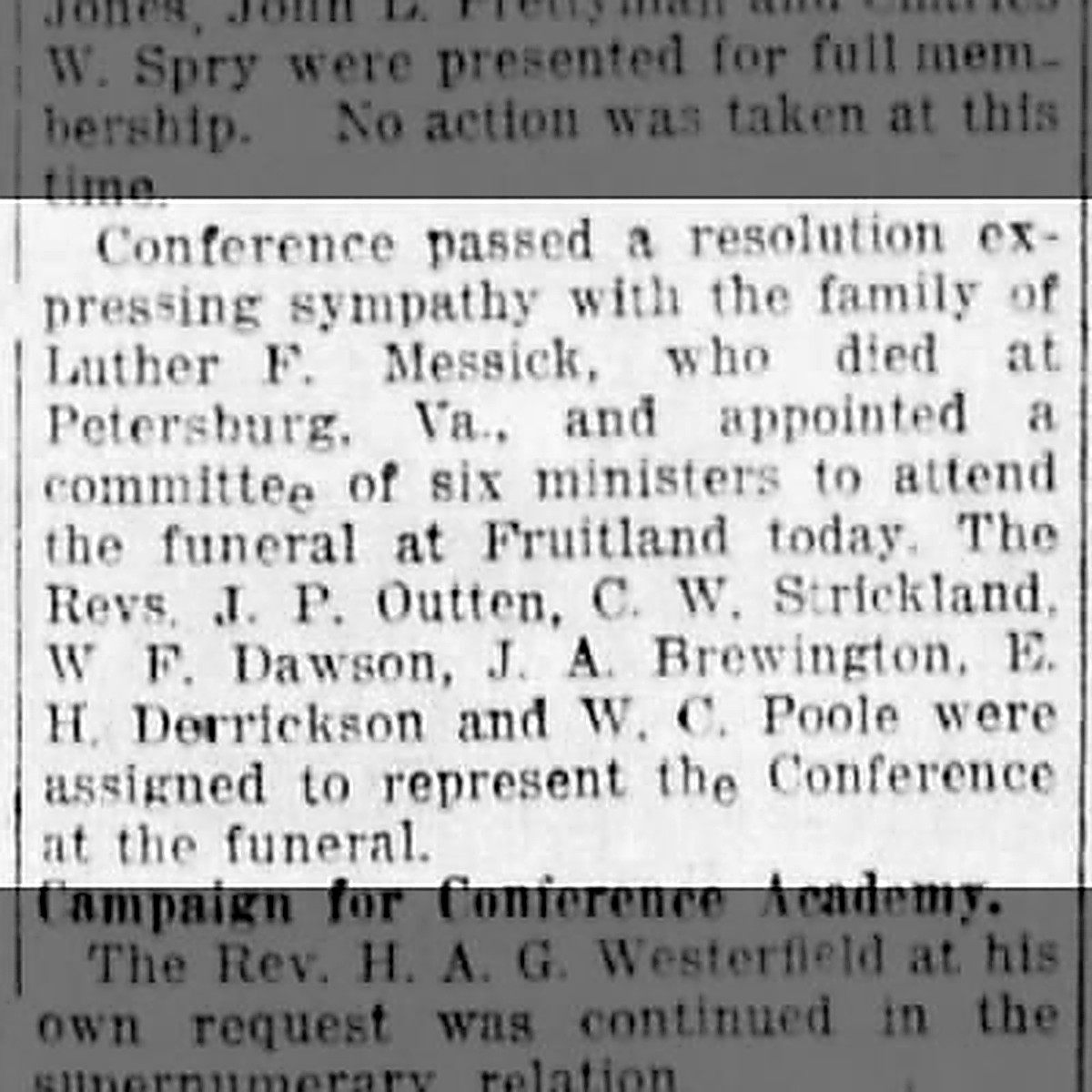
Carrie and the couple's two sons were with him when he died, as was Audrey. Contemporary and official records use several Maryland destinations for the return of his body: the death certificate gives Salisbury, an obituary says White Haven, and the Wilmington Methodist Episcopal Conference referred to his funeral at Fruitland. These statements need not contradict one another. They may describe the rail or administrative destination, the home community, and the location of the funeral and burial.
Burial and a Wesleyan epitaph
Luther was buried at St. John's Cemetery in Fruitland. His gravestone gives his death date as 27 March 1917 and his birth date as 11 January 1869. The inscription below the dates is badly weathered, but the visible lines appear to reproduce language associated with the memorial tablet to John Wesley at City Road Chapel in London.
He died in sure and certain hope of eternal life, through the atonement and mediation of a crucified Saviour.
Probable reading of the epitaph on Luther Mezick's gravestone
The choice is exceptionally appropriate. Luther's life began in a rural Methodist class, continued through decades of gospel singing and revival work, and ended while he was assisting a Methodist congregation. Whether Luther requested the words or his family selected them, the epitaph connected his own ministry to the founder of the Methodist movement.
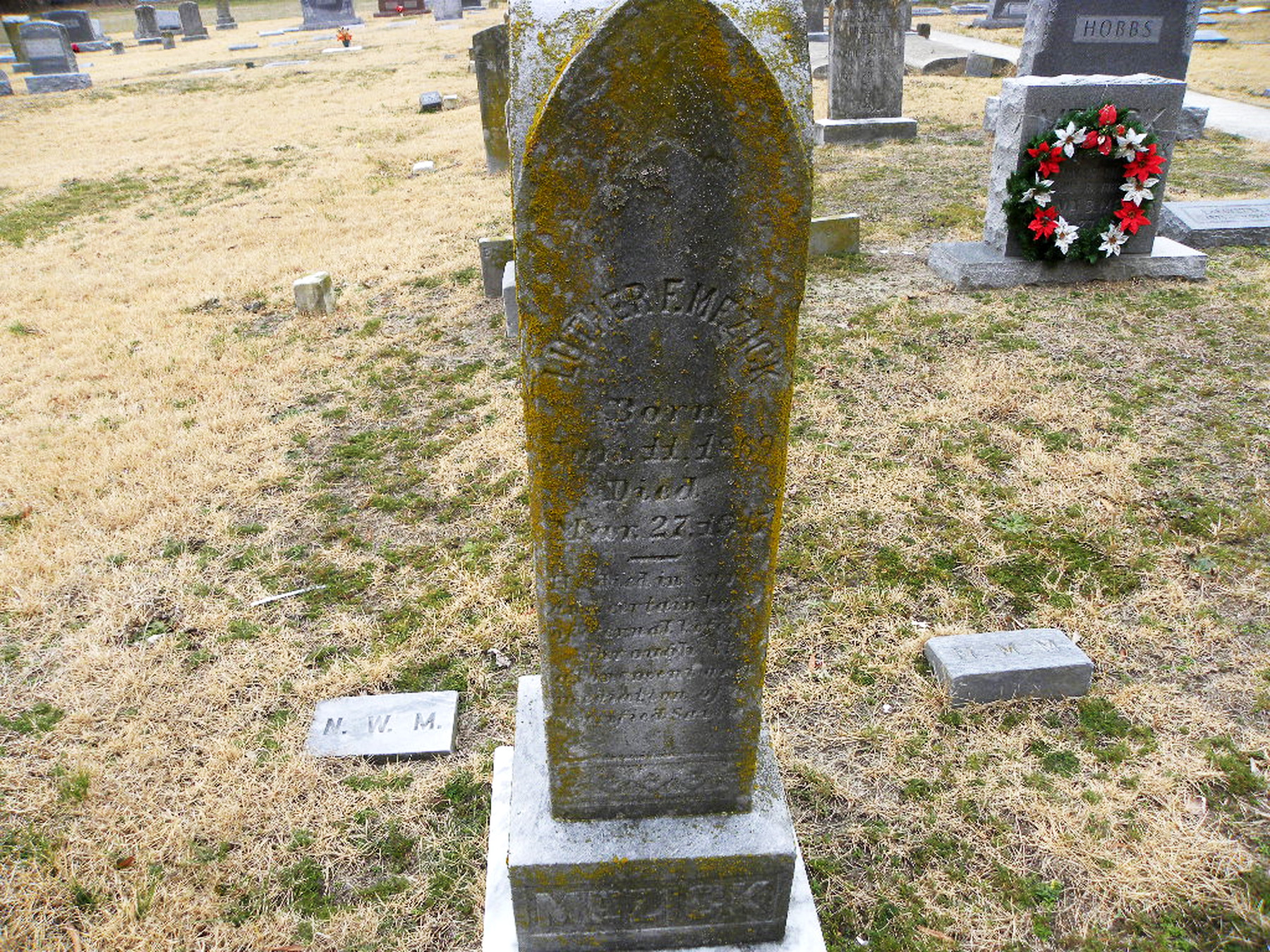
The stone gives 11 January 1869, conflicting with the 17 February date on the Virginia death certificate.
Legacy
Luther Franklin Mezick occupied a distinctive place in the religious culture of his era. He was not a nationally famous evangelist whose name entered national textbooks. His work moved through a less centralized but enormously influential world of Methodist circuits, local-option campaigns, courthouse rallies, Chautauqua tents, sacred sheet music, political conventions, and revival meetings. In those settings, music was not a decorative extra. It was a means of preaching, organizing, persuading, and binding an audience together.
His surviving record is unusually varied. A church register documents his marriage. Class lists place him and Carrie within Massey's. Newspapers trace him from a twenty-two-year-old Prohibition nominee to a nationally advertised gospel singer and candidate for the Maryland legislature. Sheet music identifies him as composer, lyricist, and publisher. A conference resolution shows the respect accorded him at death. Photographs preserve his face, the face of his father, and the public image of the Mezick singers.
His life also remained unmistakably familial. Isaac held him as an infant in the earliest photograph. Carrie shared his church community and nearly twenty-six years of marriage. Ella helped build the touring act. Audrey carried the music into its later phase. His will distributed guitars, gun, and watch among the children who survived him. Even the records now used to reconstruct his career were preserved through family hands.
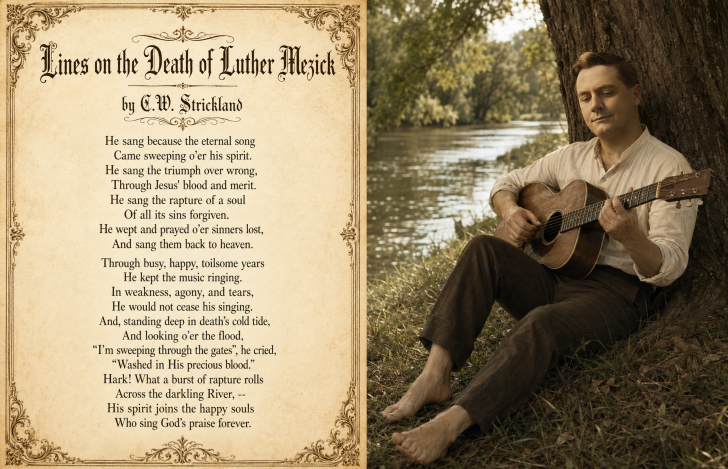
He sang because the eternal song / Came sweeping o'er his spirit. / He sang the triumph over wrong, / Through Jesus' blood and merit.
From “Lines on the Death of Luther F. Mezick,” by C. W. Strickland
The most fitting summary may be the simplest: Luther kept the music ringing. He carried the sounds and convictions of a small Eastern Shore Methodist community across the country, then returned in death to the family and church landscape from which he had begun.
Chronology
| Date | Event |
|---|---|
| 20 May 1839 | Birth of Isaac Francis Mezick, Luther's father. |
| 25 May 1840 | Birth of Elizabeth Jane White, Luther's mother. |
| 1857 | Elizabeth Jane White marries Thomas Benjamin Franklin Hughes. |
| 1864 | Traditional year of Thomas Hughes's accidental death. |
| 14 March. 1868 | Elizabeth marries Isaac Francis Mezick. |
| 11 January or 17 February 1869 | Luther Franklin Mezick is born; the date is disputed. |
| 20 November 1879 | Birth of Sarah Ella Mezick. |
| 24 June 1891 | Luther marries Carrie R. Robertson at Trinity M.E. Church. |
| 4 July 1891 | Newspaper reports Luther nominated for Wicomico County commissioner by the Prohibition Party. |
| 19 January 1893 | Birth of daughter Audrey. |
| 1897 | Luther directs music at a large local-option meeting. |
| 7 January 1898 | Birth of son Evan Carlyle. |
| 19 March 1900 | Birth of son Herbert Luther. |
| 1903 - 1908 | Growing documentary trail of gospel and temperance work: a probable 1903 Virginia singing engagement; advertised appearances with Ella in West Virginia in 1905 and 1906; an explicitly identified Luther-and-Ella Prohibition conference engagement in 1907; and Midwestern Chautauqua programs by 1908. |
| 28 April 1909 | Sarah Ella marries Prohibition organizer Prescott Gillilan. |
| 1909 | Luther offers to organize for the Prohibition Party statewide and runs for the Maryland House of Delegates. |
| January 1910 | Advertised as a featured gospel singer at a Methodist revival in Washington, D.C. |
| 14 July 1911 | Participates in the final religious services for Reese Roberts at the New Castle County Workhouse in Delaware; the next day's Philadelphia Inquirer identifies him as Rev. Luther F. Mezick, of Philadelphia, a Methodist Episcopal singing evangelist. |
| 27 March 1917 | Dies at Petersburg Hospital while engaged in revival work. |
| 30 March 1917 | Wilmington M.E. Conference records sympathy and representation at the Fruitland funeral. |
| 20 July 1946 | Death of Carrie Robertson Mezick. |
| 16 March 1970 | Death of Sarah Ella Mezick Gillilan in Columbus, Ohio. |
Source notes and evidence guide
The biography uses the following categories of evidence. Original records and contemporary newspapers carry the greatest weight for events they directly document. Family traditions and later compilations remain valuable, but they are identified as such when they cannot yet be independently confirmed.
Birth and death: Virginia death certificate for Luther Franklin Mezick; photograph of the gravestone at St. John's Cemetery; Petersburg obituary material supplied by the family.
Parents and siblings: Family research supplied by Shari Handley; Handley's Eastern Shore Maryland Genealogy Project; family tintype of Isaac Francis Mezick with the infant Luther.
Elizabeth Jane White: Family research and marriage information supplied by Shari Handley. The hogshead-of-whiskey accident is family tradition. The statement that Elizabeth had fourteen children has not been relocated or verified.
Church and marriage: Massey's Methodist class lists and the Trinity M.E. Church marriage register entry dated 24 June 1891.
Political work: Salisbury Advertiser and other contemporary Maryland newspaper clippings supplied by Shari Handley, including the 1891 county ticket and 1909 legislative nomination.
Music and touring: Contemporary newspaper notices and advertisements from Maryland, Virginia, West Virginia, Pennsylvania, Kansas, Illinois, and Washington, D.C.; surviving cover of Song of Meditation; notice for God's Calling. The Library of Congress William Huber, Jr. Collection finding aid independently catalogs God's Calling under Luther F. Mezick.
Sarah Ella Mezick: Family research supplied by Shari Handley, supported by contemporary touring advertisements. Her marriage date is 28 April 1909; an older family web page contains a 1919 typographical error.
Audrey and the children: Family compilation and the Howard and Marvin E. Cox ledger/journal, which identifies Audrey Moore and Herbert L. Mezick as children of Luther. Luther's will also distinguishes a daughter and two sons.
Additional online newspaper research, August 2026: The following online newspaper records were used to expand and refine the public-career narrative: Peninsula Enterprise, 11 July 1903; Fairmont West Virginian, 18 February 1905; Fairmont West Virginian, 23 April 1906; Cumberland Evening Times, 30 August 1907; and Philadelphia Inquirer, 15 July 1911. A later Somerset County newspaper retrospective preserves the Atlantic City Prohibition-convention item, but the original issue date remains to be established.
Institutional music catalog: The Library of Congress William Huber, Jr. Collection finding aid lists God's Calling under Luther F. Mezick, providing an independent institutional catalog reference for the composition.
Unresolved 1913 lead: A NewspaperArchive page dated 27 August 1913 contains OCR referring to “Prof. Mezick of Maryland” and a Pennsylvania state league, but the same OCR also contains an Accomac Court House dateline from August 1903 and language closely resembling a 1903 notice. Because the page metadata and extracted text appear to be mixed or otherwise unreliable, this biography does not currently use that item as evidence of a 1913 engagement. See Big Stone Gap Post archive page.
Death and funeral: Virginia death certificate; Petersburg obituary; Wilmington Methodist Episcopal Conference report of 30 March 1917.
Epitaph: Photographs of Luther's gravestone and comparison with the wording of John Wesley's memorial inscription. The reading is highly probable but portions of the stone are weathered.
Images: All historic images and clippings were supplied by Shari Handley. The cleaned monochrome and colorized Isaac-and-Luther portraits are modern AI-assisted interpretations based on the original tintype.
Selected image credits
- Cover: restored family portrait of Luther Franklin Mezick.
- Isaac and infant Luther: copy of original family tintype; monochrome and colorized restorations created from the supplied image.
- Marriage record: Trinity Methodist Episcopal Church register, 24 June 1891.
- Newspaper clippings: family research collection assembled from historical newspapers.
- Sheet music: Song of Meditation, words and music by Luther F. Mezick, published at White Haven, Maryland.
- Gravestone: Luther F. Mezick, St. John's Cemetery, Fruitland, Maryland.